If you’re searching for how to register my dog in Hays County, Texas, the most important thing to know is that pet “registration” and licensing are typically handled locally—most often by the city you live in (such as Kyle, Buda, or San Marcos) or, if you live outside city limits, by county-level animal control. In nearly all cases, current rabies vaccination is the key document you’ll need to obtain or maintain a dog license in Hays County, Texas.
This page walks you through who enforces animal rules, where to register a dog in Hays County, Texas, what paperwork to gather, and how dog licensing differs from service dog legal status and emotional support animal rules.
Where to Register or License Your Dog in Hays County, Texas
Because requirements are often city-based, below are several example official offices within Hays County that may handle pet registration, licensing, rabies compliance questions, animal control calls, or shelter intake. Use the office that matches your jurisdiction (city limits vs. unincorporated Hays County). Do not rely on third-party services for an animal control dog license Hays County, Texas process—start with the local government office.
City of Kyle Animal Control / Animal Services (Kyle Police Department)
| Address | 1700 Kohler’s Crossing |
|---|---|
| City/State/ZIP | Kyle, TX 78640 |
| Phone | 512-268-0859 (administration/animal control contact listed by the city) |
| KPD-ACO@cityofkyle.com | |
| Office hours | Monday–Friday, 8:00 am–5:00 pm (in-person guidance listed by the city for animal services tasks) |
Kyle’s official guidance describes submitting a registration form plus rabies certificate and fees at the address above.
City of Buda Animal Control (Buda Police Department)
| Address | 405 E. Loop Street, Building 100 |
|---|---|
| City/State/ZIP | Buda, TX 78610 |
| Phone | 512-312-0084 |
| animalcontrol@budatx.gov | |
| Office hours | Not listed in the official registration page content used for this summary. |
Buda’s official registration guidance notes rabies vaccination and a microchip or tag; it also describes how to submit updated proof of rabies vaccination.
San Marcos Regional Animal Shelter (City of San Marcos)
| Address | 750 River Road |
|---|---|
| City/State/ZIP | San Marcos, TX 78666 |
| Phone | 512-805-2657 (adoptions) / 512-805-2655 (resources listed for found stray guidance) |
| Not listed on the shelter hours/location page content used for this summary. | |
| Office hours |
Adoption Center Hours
Mon 12:00 pm–5:00 pm
Tues 12:00 pm–7:00 pm
Wed CLOSED
Thur 12:00 pm–7:00 pm
Fri 12:00 pm–5:00 pm
Sat 12:00 pm–7:00 pm
Sun 12:00 pm–5:00 pm
Receiving / Reclaim Hours
Mon 11:00 am–6:00 pm
Tues 11:00 am–6:00 pm
Wed 11:00 am–6:00 pm
Thur 11:00 am–6:00 pm
Fri 11:00 am–6:00 pm
Sat CLOSED
Sun CLOSED
|
The City of San Marcos describes this shelter as the stray animal open-intake facility for all of Hays County.
City of Mustang Ridge – Animal Control (official city listing)
| Address | 12800 Highway 183 South |
|---|---|
| City/State/ZIP | Mustang Ridge, TX 78610 |
| Phone | 512-243-1775 |
| Not listed on the city’s animal control page content used for this summary. | |
| Office hours | Not listed on the city’s animal control page content used for this summary. |
Hays County Sheriff’s Office – Animal Control (unincorporated areas)
If you live in unincorporated Hays County (outside the city limits of San Marcos, Kyle, and Buda), county animal control is handled through the Hays County Sheriff’s Office Animal Control program, which also notes that Hays County contracts with the San Marcos Animal Shelter for housing stray/impounded animals.
| Phone | 512-393-7896 (Sheriff’s Office number shown on the county Sheriff’s Office page) |
|---|---|
| Not published on the animal control page content used for this summary (only a generic “Questions/Help” reference is shown). | |
| Office hours | Not listed on the county animal control page content used for this summary. |
If your address is inside a city limit, contact that city’s animal control/animal services first.
Overview of Dog Licensing in Hays County, Texas
What people mean by “registering” a dog
In everyday conversation, “registering” can mean different things: getting a city-issued pet registration tag, obtaining a dog license, updating a microchip database, or simply proving rabies vaccination. In Hays County, the phrase often points to the local government process used to identify pet owners and support rabies compliance—especially when animal control is responding to calls or when a pet is found as a stray.
Who is responsible in Hays County?
Hays County is not a single uniform licensing jurisdiction. Instead, the responsible agency depends on where you live:
- Inside city limits: the city’s animal control/animal services typically administers licensing/registration requirements (for example, the City of Kyle and the City of Buda each publish their own registration requirements and contact details).
- Outside city limits (unincorporated areas): animal control services are provided by the Hays County Sheriff’s Office Animal Control Officers, with the county noting that it contracts with the regional shelter in San Marcos for housing impounded animals.
Rabies vaccination is central
Nearly every official pet registration or licensing program is built around proof of current rabies vaccination. For example, Buda’s official requirements list current rabies vaccinations as required for registration, and Kyle’s official instructions for pet registration also require a rabies vaccination certificate. Rabies compliance is also closely tied to animal control and shelter processes (including rabies quarantine protocols when bites occur).
Key SEO terms (and what they typically mean)
When residents search online for a dog license in Hays County, Texas or animal control dog license Hays County, Texas, they are usually looking for the correct local office and the steps to submit rabies documentation, residency proof (when required), and fees. This page is designed to answer exactly that—starting with where to register a dog in Hays County, Texas based on jurisdiction.
How Dog Licensing Works Locally in Hays County, Texas
Step 1: Confirm your jurisdiction (city limits vs. county)
Start by identifying whether your address is within a city’s limits (Kyle, Buda, San Marcos, or another incorporated city/town in Hays County). This matters because the Hays County Sheriff’s Office Animal Control program notes it patrols the county except certain cities that handle their own municipal animal control coverage. If you live in a city, you generally follow that city’s registration/licensing rules.
Step 2: Gather your documents (what offices commonly require)
While the exact list can vary, common requirements for a local pet registration or dog license process include:
- Rabies vaccination certificate (proof the dog is currently vaccinated)
- Owner identification (often a government-issued ID)
- Proof of residency (especially for city-based programs)
- Payment of registration/licensing fee (varies by city and whether the pet is altered)
Step 3: Submit your application locally (examples)
Here are examples of how local registration is described by official city sources within Hays County:
- City of Kyle: the city’s animal services instructions describe submitting a completed pet registration form, a rabies vaccination certificate, and a registration fee to the Kyle Police Department address listed above. The city also provides an email contact for sending an application and documents for certain animal services processes.
- City of Buda: the city’s official animal registration guidance lists current rabies vaccination and a microchip or tag as requirements, and it provides instructions for maintaining registration by keeping rabies proof up to date (including an email address for submitting updated proof).
Step 4: Keep your registration current
Local requirements often involve more than a one-time transaction. For example, Buda’s official registration guidance explains that registration must be maintained by keeping rabies vaccination proof current and resubmitting updated proof after expiration. Even in places where the “license” is annual, rabies vaccination is time-limited and must be updated on schedule (your veterinarian can tell you whether your dog is on a 1-year or 3-year rabies vaccine interval based on medical history and applicable rules).
What the regional shelter does (and why it matters)
The San Marcos Regional Animal Shelter is described by the City of San Marcos as the open-intake stray animal facility for all of Hays County. Practically, this affects what happens if a dog is impounded, found as a stray, or surrendered, and it can impact reclaim procedures, proof requirements, and where to go in person—especially if your dog is picked up outside your city’s normal business hours.
Rabies vaccination requirements (plain-English explanation)
Rabies is a public health issue, and Texas and local jurisdictions treat it accordingly. At the local level, rabies rules show up as: required vaccinations, required documentation, and special procedures if a bite occurs (including quarantine/observation requirements). In Hays County, city registration programs explicitly require rabies documentation, and animal control/shelter operations may coordinate rabies-related quarantines when needed.
Service Dog Laws in Hays County, Texas
Service dog status is not the same as a local dog license
A service dog is defined by what the dog does—trained work or tasks that assist a person with a disability. That legal status is separate from a local requirement to obtain a dog license in Hays County, Texas (or a city pet registration). In other words:
- Service dog status is a disability access issue (where the dog is allowed to accompany the handler).
- Local licensing/registration is an animal control/public health identification and rabies compliance issue.
What businesses can ask (and what they can’t)
In general, when it’s not obvious what service the dog provides, staff may ask limited questions focused on whether the dog is required because of a disability and what tasks it is trained to perform. They typically should not demand “registration papers,” special vests, or online certificates as proof of service dog status. Even so, local animal rules like leash requirements and nuisance behavior rules still apply.
Service dogs still need rabies vaccination and local compliance
A service dog generally must still comply with local public health rules: current rabies vaccination, restraint/leash rules, and any applicable local licensing or registration requirements. If you’re working on where to register a dog in Hays County, Texas and your dog is a service dog, you can usually follow the same local city/county process—starting with the office list above.
Emotional Support Animal Rules in Hays County, Texas
An ESA is not a service dog under public access rules
An emotional support animal (ESA) provides comfort by presence and may be recommended by a licensed healthcare professional in certain contexts, but an ESA is generally not the same as a trained service dog for public access. This distinction matters because:
- Service dogs have broader public access protections when trained to perform tasks for a disability.
- ESAs are typically addressed in housing-related contexts (and rules can be different from public places like restaurants or stores).
Local licensing is still local (ESA does not replace registration)
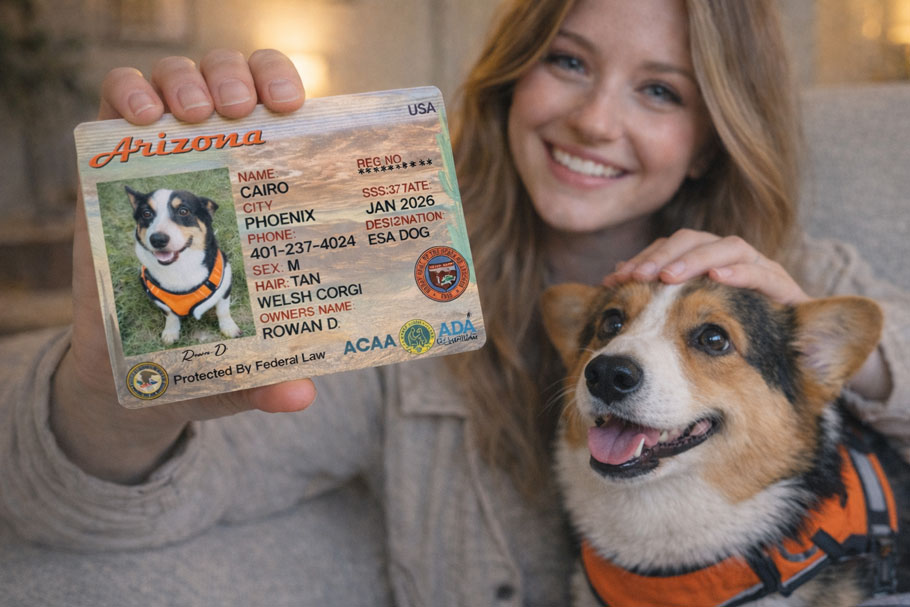
Even if your dog is an ESA, you may still need to follow the same local requirements for a city pet registration or animal control dog license Hays County, Texas process—especially rabies vaccination documentation. “ESA certificates” from third-party websites generally do not replace official local registration requirements.
Practical guidance for ESA owners in Hays County
If you need to register your dog locally, use the office list above and prepare your rabies certificate and any residency documentation required by your city. If you have housing questions related to an ESA, keep those separate from local animal licensing: one is an animal control/public health identification process; the other concerns housing accommodations and documentation.
Frequently Asked Questions
Quick recap: how to register your dog locally
- Confirm whether you live inside city limits (Kyle, Buda, San Marcos, etc.) or in unincorporated Hays County.
- Gather your rabies vaccination proof and any residency/ID documents required by your jurisdiction.
- Contact the official office listed above for your area and follow the city/county instructions for a dog license or registration tag.
- Keep rabies documentation current and update contact information so animal services can reach you quickly if your pet is found.